Introduction
George Washington’s words offer timeless lessons about leadership, freedom, honesty, discipline, and the responsibilities of citizenship. As the first president of the United States and commander-in-chief of the Continental Army, he helped shape the nation’s early political traditions through military service, public leadership, letters, and presidential addresses.
In this collection of George Washington Quotes, you’ll find memorable historical passages, explanations of their meanings, short excerpts for social media, and guidance for checking whether a quotation is authentic. Whether you’re researching American history, looking for inspiration, or creating an educational quote graphic, this guide helps you explore his words with greater context.
1. Best George Washington Quotes About Life and Wisdom
Washington’s advice often emphasized sound judgment, personal responsibility, and the importance of acting according to principle. These passages are useful starting points for reflecting on everyday decisions and the relationship between character and reputation.
- “Be courteous to all, but intimate with few.” — George Washington, commonly reproduced from his rules of civility.
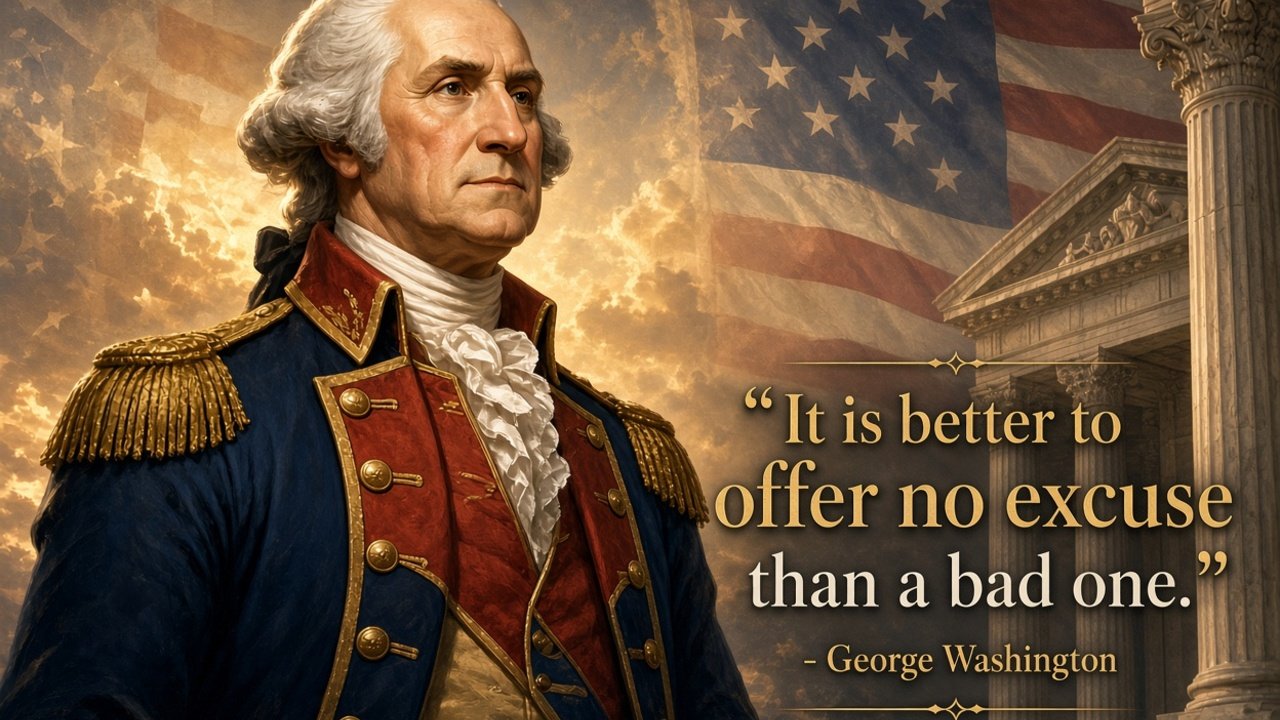
- “It is better to offer no excuse than a bad one.” — Commonly attributed to Washington; verify the original wording before formal use.
- “Associate with men of good quality if you esteem your own reputation.” — George Washington, from his rules of civility.
- “Labor to keep alive in your breast that little spark of celestial fire, called conscience.” — George Washington.
- “Truth will ultimately prevail where there is pains to bring it to light.” — George Washington.
- “Happiness and moral duty are inseparably connected.” — George Washington, First Inaugural Address.
- “I hold the maxim no less applicable to public than to private affairs, that honesty is the best policy.” — George Washington.
- “The preservation of the sacred fire of liberty” — phrase from his First Inaugural Address.
- “Observe good faith and justice toward all nations.” — George Washington, Farewell Address.
- “Cultivate peace and harmony with all.” — George Washington, Farewell Address.
- “Guard against the impostures of pretended patriotism.” — George Washington, Farewell Address.
- “The name of American, which belongs to you, in your national capacity, must always exalt the just pride of Patriotism.” — George Washington, Farewell Address.
- “The unity of government which constitutes you one people is also now dear to you.” — George Washington, Farewell Address.
- “It is our true policy to steer clear of permanent alliances with any portion of the foreign world.” — George Washington, Farewell Address.
- “The time is now near at hand which must probably determine whether Americans are to be freemen or slaves.” — Washington, Revolutionary-era writing; consult the original document for exact wording and context.
Meaning: Wisdom requires more than intelligence. It involves honest judgment, thoughtful relationships, and the willingness to recognize the consequences of one’s decisions. Washington’s writings also show how personal principles were connected to public responsibility.
2. Famous George Washington Quotes That Still Inspire Today
Some of Washington’s best-known passages come from speeches and letters written during periods of uncertainty. Their enduring appeal lies in their emphasis on conscience, perseverance, unity, and service rather than personal recognition.
- “The Constitution is the guide which I will never abandon.” — Commonly attributed to Washington; verify the exact source.
- “A free people ought not only to be armed, but disciplined.” — George Washington, First Annual Message to Congress, 1790.
- “To be prepared for war is one of the most effectual means of preserving peace.” — Commonly attributed to Washington; confirm the original text before publication.
- “I had rather be on my farm than be emperor of the world.” — Commonly attributed to Washington; verify the precise wording.
- “The government of the United States … gives to bigotry no sanction, to persecution no assistance.” — George Washington, letter to the Hebrew Congregation in Newport, 1790; this is a shortened excerpt.
- “It is our true policy to steer clear of permanent alliances with any portion of the foreign world.” — Farewell Address.
- “Observe good faith and justice toward all nations.” — Farewell Address.
- “Cultivate peace and harmony with all.” — Farewell Address.
- “Guard against the impostures of pretended patriotism.” — Farewell Address.
- “Happiness and moral duty are inseparably connected.” — First Inaugural Address.
- “The preservation of the sacred fire of liberty” — First Inaugural Address.
- “The name of American” — a phrase from the Farewell Address, which discusses national identity.
- “Truth will ultimately prevail where there is pains to bring it to light.” — Washington’s writings.
- “Labor to keep alive in your breast that little spark of celestial fire, called conscience.” — Washington’s rules of civility.
- “Be courteous to all, but intimate with few.” — Washington’s rules of civility.
Meaning: Inspirational historical writing can help readers consider how they respond to pressure, uncertainty, and responsibility. These excerpts are especially useful when paired with their original documents instead of shared without context.
For publication, distinguish verified wording from shortened excerpts and commonly attributed sayings. The National Archives preserves Washington’s First Inaugural Address, while Mount Vernon documents numerous quotations that have been wrongly credited to him.
National Archives
+1
3. George Washington Quotes About Leadership
Washington’s leadership involved commanding an army, helping establish a constitutional government, and setting precedents for the presidency. His historical example also demonstrates the importance of institutional responsibility and restraint in the use of power.
- “I hold the maxim no less applicable to public than to private affairs, that honesty is the best policy.”
- “A free people ought not only to be armed, but disciplined.”
- “The Constitution is the guide which I will never abandon.” — Verify the original source before quoting.
- “Let us raise a standard to which the wise and honest can repair.” — Commonly attributed to Washington; check the original wording.
- “Labor to keep alive in your breast that little spark of celestial fire, called conscience.”
- “Observe good faith and justice toward all nations.”
- “Cultivate peace and harmony with all.”
- “Guard against the impostures of pretended patriotism.”
- “The unity of government which constitutes you one people is also now dear to you.”
- “The name of American, which belongs to you, in your national capacity, must always exalt the just pride of Patriotism.”
- “The preservation of the sacred fire of liberty.”
- “Happiness and moral duty are inseparably connected.”
- “It is our true policy to steer clear of permanent alliances with any portion of the foreign world.”
- “The time is now near at hand which must probably determine whether Americans are to be freemen or slaves.”
- “The great object, for which I had the honor to hold an appointment in the service of my country being accomplished…” — From Washington’s 1783 resignation-era address; this is an opening excerpt, not a complete quotation.
Meaning: Effective leadership combines preparation, integrity, and accountability. Washington’s public career is particularly significant because he resigned his military command after the Revolutionary War and later left the presidency after two terms. His example provides a useful historical case study in the relationship between leadership and limits on personal power.
4. George Washington Quotes About Freedom and Liberty
Freedom was central to the American Revolution and the creation of the United States. Washington’s writings discuss independence, constitutional government, and the institutions needed to preserve liberty.
- “The preservation of the sacred fire of liberty.” — First Inaugural Address.
- “A free people ought not only to be armed, but disciplined.” — First Annual Message to Congress, 1790.
- “Observe good faith and justice toward all nations.” — Farewell Address.
- “Cultivate peace and harmony with all.” — Farewell Address.
- “The unity of government which constitutes you one people is also now dear to you.” — Farewell Address.
- “The name of American” — Farewell Address.
- “It is our true policy to steer clear of permanent alliances with any portion of the foreign world.” — Farewell Address.
George Washington Quotes About Honesty and Integrity
- “The Constitution is the guide which I will never abandon.” — Verify the source and wording before publication.
- “The time is now near at hand which must probably determine whether Americans are to be freemen or slaves.” — Revolutionary-era writing; consult the original document.
- “If in the opinion of the People, the distribution or modification of the Constitutional Powers be in any particular wrong, let it be corrected by an amendment in the way which the Constitution designates.” — Farewell Address, with historical capitalization and punctuation varying by transcription.
- “The government of the United States … gives to bigotry no sanction, to persecution no assistance.” — Letter to the Hebrew Congregation in Newport, 1790; shortened excerpt.
- “I now make it my earnest prayer, that God would have the State over which you preside in his holy protection.” — Washington’s circular letter to the states; verify the full passage before quoting.
- “Happiness and moral duty are inseparably connected.” — First Inaugural Address.
- “Truth will ultimately prevail where there is pains to bring it to light.”
- “Labor to keep alive in your breast that little spark of celestial fire, called conscience.”
Meaning: Washington’s writings connect liberty with constitutional procedures, civic duties, and national stability. A complete historical discussion should also acknowledge the contradiction between revolutionary ideals of freedom and Washington’s ownership of enslaved people during much of his life.
5. George Washington Quotes About America and Patriotism
Washington helped lead the struggle for independence and became the first president under the Constitution. His Farewell Address urged Americans to think about national unity, responsible citizenship, and the dangers of allowing political divisions to weaken the country.
- “The name of American, which belongs to you, in your national capacity, must always exalt the just pride of Patriotism.”
- “The unity of government which constitutes you one people is also now dear to you.”
- “Observe good faith and justice toward all nations.”
- “Cultivate peace and harmony with all.”
- “Guard against the impostures of pretended patriotism.”
- “It is our true policy to steer clear of permanent alliances with any portion of the foreign world.”
- “The preservation of the sacred fire of liberty.”
- “Happiness and moral duty are inseparably connected.”
- “A free people ought not only to be armed, but disciplined.”
- “The Constitution is the guide which I will never abandon.” — Verify its source.
- “Labor to keep alive in your breast that little spark of celestial fire, called conscience.”
- “Truth will ultimately prevail where there is pains to bring it to light.”
- “The time is now near at hand which must probably determine whether Americans are to be freemen or slaves.”
- “The great object, for which I had the honor to hold an appointment in the service of my country being accomplished…” — 1783 address excerpt.
- “Among the vicissitudes incident to life, no event could have filled me with greater anxieties…” — Opening words of Washington’s First Inaugural Address, with the complete transcript available from the National Archives.
National Archives
+1
Meaning: Patriotism in Washington’s writings is closely tied to the survival of the Union and the responsibilities of self-government. These passages can support thoughtful conversations about citizenship, history, national identity, and public service.
6. George Washington Quotes About Honesty and Integrity
Honesty and conscience are recurring themes in the advice associated with Washington. His words can help readers think about ethical choices, personal accountability, and the importance of earning trust.
- “I hold the maxim no less applicable to public than to private affairs, that honesty is the best policy.”
- “Labor to keep alive in your breast that little spark of celestial fire, called conscience.”
- “Truth will ultimately prevail where there is pains to bring it to light.”
- “Be courteous to all, but intimate with few.”
- “Associate with men of good quality if you esteem your own reputation.”
- “Guard against the impostures of pretended patriotism.”
- “Happiness and moral duty are inseparably connected.”
- “Observe good faith and justice toward all nations.”
- “Cultivate peace and harmony with all.”
- “The preservation of the sacred fire of liberty.”
- “The unity of government which constitutes you one people is also now dear to you.”
- “The name of American, which belongs to you, in your national capacity, must always exalt the just pride of Patriotism.”
- “The Constitution is the guide which I will never abandon.” — Verify the source before use.
- “The government of the United States … gives to bigotry no sanction, to persecution no assistance.” — Shortened excerpt from the Newport letter.
- “If in the opinion of the People, the distribution or modification of the Constitutional powers be in any particular wrong, let it be corrected by an amendment in the way which the Constitution designates.”
Meaning: Integrity means more than saying the right thing. It means acting consistently, recognizing mistakes, and accepting responsibility for decisions. For modern readers, these themes apply to schoolwork, professional relationships, public service, and everyday communication.
7. George Washington Quotes About Friendship and Good Company
Washington’s advice about relationships emphasizes courtesy, careful judgment, and the influence of one’s companions. These passages are particularly relevant for readers thinking about trust, reputation, and choosing friends.
- “Be courteous to all, but intimate with few.”
- “Associate with men of good quality if you esteem your own reputation.”
- “It is far better to be alone than to be in bad company.” — Commonly attributed; verify the source.
- “True friendship is a plant of slow growth.” — Commonly attributed to Washington; confirm its documentary source before presenting it as verified.
- “Nothing is a greater stranger to my breast, or a sin that my soul more abhors, than that black and detestable one, ingratitude.” — Commonly reproduced as Washington’s words; check the original document and punctuation.
- “Cultivate peace and harmony with all.”
- “Observe good faith and justice toward all nations.”
- “Truth will ultimately prevail where there is pains to bring it to light.”
- “Labor to keep alive in your breast that little spark of celestial fire, called conscience.”
- “Happiness and moral duty are inseparably connected.”
- “The name of American” — a phrase from the Farewell Address about shared national identity.
- “The unity of government which constitutes you one people is also now dear to you.”
- “Guard against the impostures of pretended patriotism.”
- “The preservation of the sacred fire of liberty.”
- “I hold the maxim no less applicable to public than to private affairs, that honesty is the best policy.”
Meaning: Good relationships grow through trust, gratitude, and consistent behavior. Washington’s advice is not a demand to avoid people; rather, it encourages readers to be courteous while choosing close relationships thoughtfully.
For a modern caption inspired by this theme, you can write: Choose friends who respect your values, celebrate your growth, and tell you the truth. This is original wording inspired by the topic, not a historical Washington quotation.
8. George Washington Quotes About Courage and Discipline
Washington’s military career required persistence, organization, and the ability to work through severe challenges. His writings about military readiness are especially useful when discussing preparation, teamwork, and responsible decision-making.
- “A free people ought not only to be armed, but disciplined.”
- “To be prepared for war is one of the most effectual means of preserving peace.” — Verify the exact source and wording.
- “The time is now near at hand which must probably determine whether Americans are to be freemen or slaves.”
- “The great object, for which I had the honor to hold an appointment in the service of my country being accomplished…” — 1783 address excerpt.
- “Among the vicissitudes incident to life, no event could have filled me with greater anxieties…” — First Inaugural Address excerpt.
- “Happiness and moral duty are inseparably connected.”
- “Labor to keep alive in your breast that little spark of celestial fire, called conscience.”
- “Truth will ultimately prevail where there is pains to bring it to light.”
- “Observe good faith and justice toward all nations.”
- “Cultivate peace and harmony with all.”
- “Guard against the impostures of pretended patriotism.”
- “The preservation of the sacred fire of liberty.”
- “The unity of government which constitutes you one people is also now dear to you.”
- “It is our true policy to steer clear of permanent alliances with any portion of the foreign world.”
- “The name of American, which belongs to you, in your national capacity, must always exalt the just pride of Patriotism.”
Meaning: Courage is not simply the absence of fear. It can mean staying disciplined, preparing for uncertainty, and continuing to fulfill a responsibility when circumstances are difficult. Washington’s experience also shows why preparation and teamwork matter in high-pressure situations.
9. George Washington Quotes About Education and Knowledge
Education helps people understand history, assess evidence, and make informed decisions. Washington’s writing offers a useful starting point for discussing learning, practical judgment, and the responsibilities of an informed citizen.
- “Truth will ultimately prevail where there is pain to bring it to light.”
- “Labor to keep alive in your breast that little spark of celestial fire, called conscience.”
- “Happiness and moral duty are inseparably connected.”
- “The Constitution is the guide which I will never abandon.” — Verify the original source before quoting.
- “The preservation of the sacred fire of liberty.”
- “A free people ought not only to be armed, but disciplined.”
- “Observe good faith and justice toward all nations.”
George Washington Quotes About Leadership
- “Cultivate peace and harmony with all.”
- “Guard against the impostures of pretended patriotism.”
- “The unity of government which constitutes you one people is also now dear to you.”
- “The name of American, which belongs to you, in your national capacity, must always exalt the just pride of Patriotism.”
- “It is our true policy to steer clear of permanent alliances with any portion of the foreign world.”
- “Among the vicissitudes incident to life, no event could have filled me with greater anxieties…” — First Inaugural Address excerpt.
- “The great object, for which I had the honor to hold an appointment in the service of my country being accomplished…” — 1783 address excerpt.
- “The time is now near at hand which must probably determine whether Americans are to be freemen or slaves.”
Meaning: These passages are not all direct statements about education. Instead, they provide material for exploring the relationship between knowledge, conscience, civic life, and historical understanding. When writing a school assignment, choose a passage that genuinely supports the topic and cite its original document.
For additional research, the National Archives provides a transcription of Washington’s First Inaugural Address, which is more dependable for academic use than an unattributed quote image.
National Archives
+1
10. George Washington Quotes About God, Faith, and Religion
Washington used religious language in several public addresses and letters. His writings refer to providence, moral responsibility, and religious liberty, making it important to consider both the original wording and the historical context.
- “Happiness and moral duty are inseparably connected.” — First Inaugural Address.
- “The government of the United States … gives to bigotry no sanction, to persecution no assistance.” — Newport letter, 1790; shortened excerpt.
- “The preservation of the sacred fire of liberty.” — First Inaugural Address.
- “I now make it my earnest prayer, that God would have the State over which you preside in his holy protection.” — From Washington’s circular letter to the states; check the complete document.
- “Among the vicissitudes incident to life, no event could have filled me with greater anxieties…” — First Inaugural Address.
- “Observe good faith and justice toward all nations.”
- “Cultivate peace and harmony with all.”
George Washington Quotes About Freedom and Liberty
- “Labor to keep alive in your breast that little spark of celestial fire, called conscience.”
- “Truth will ultimately prevail where there is pains to bring it to light.”
- “Guard against the impostures of pretended patriotism.”
- “The unity of government which constitutes you one people is also now dear to you.”
- “The name of American, which belongs to you, in your national capacity, must always exalt the just pride of Patriotism.”
- “The time is now near at hand which must probably determine whether Americans are to be freemen or slaves.”
- “The great object, for which I had the honor to hold an appointment in the service of my country being accomplished…” — Address excerpt.
- “The government of the United States … gives to bigotry no sanction, to persecution no assistance.” — A repeated short excerpt of particular importance to religious tolerance; it is included here because it is central to this topic, not as a separate quotation.
Meaning: Washington’s religious language reflects the political and cultural world of the eighteenth century. His 1790 letter to the Hebrew Congregation in Newport is especially significant for its rejection of government-backed religious persecution. Read the original letter before interpreting it as a statement about modern religious debates.
11. George Washington Quotes About Government and Democracy
Washington’s presidency helped establish precedents for the new constitutional system. His writings discuss national unity, constitutional processes, political factions, and the relationship between government and public trust.
- “I hold the maxim no less applicable to public than to private affairs, that honesty is the best policy.”
- “The unity of government which constitutes you one people is also now dear to you.”
- “It is our true policy to steer clear of permanent alliances with any portion of the foreign world.”
- “Observe good faith and justice toward all nations.”
- “Cultivate peace and harmony with all.”
- “Guard against the impostures of pretended patriotism.”
- “The preservation of the sacred fire of liberty.”
- “The Constitution is the guide which I will never abandon.” — Confirm the exact source before use.
- “If in the opinion of the People, the distribution or modification of the Constitutional powers be in any particular wrong, let it be corrected by an amendment in the way which the Constitution designates.”
- “A free people ought not only to be armed, but disciplined.”
- “Happiness and moral duty are inseparably connected.”
- “The name of American, which belongs to you, in your national capacity, must always exalt the just pride of Patriotism.”
- “The time is now near at hand which must probably determine whether Americans are to be freemen or slaves.”
- “The government of the United States … gives to bigotry no sanction, to persecution no assistance.”
- “Among the vicissitudes incident to life, no event could have filled me with greater anxieties…” — First Inaugural Address excerpt.
Meaning: Washington’s political writing reflects concern for institutional stability and the dangers of excessive factionalism. His Farewell Address remains an important primary source for studying his views on national unity and foreign policy. Readers should distinguish his historical recommendations from present-day interpretations.
12. George Washington Farewell Address Quotes and Their Meaning
Published in September 1796, Washington’s Farewell Address is one of his most influential political documents. It discusses national unity, political factions, public credit, constitutional government, and international relations. Read the complete address to understand how its themes fit together.
1. On national identity: “The name of American, which belongs to you, in your national capacity, must always exalt the just pride of Patriotism.”
Meaning: Washington encouraged citizens to recognize their shared national identity, even when their state or regional interests differed.
2. On international conduct: “Observe good faith and justice toward all nations.”
Meaning: This passage presents fairness and honorable conduct as principles of foreign relations.
3. On peace: “Cultivate peace and harmony with all.”
Meaning: Washington urged the new nation to seek peaceful relations rather than treating conflict as the default response.
4. On foreign alliances: “It is our true policy to steer clear of permanent alliances with any portion of the foreign world.”
Meaning: He expressed concern about the risks of long-term international commitments. This statement belongs to its particular historical context and should not be treated as a complete guide to every modern foreign-policy question.
5. On constitutional change: “If in the opinion of the People, the distribution or modification of the Constitutional powers be in any particular wrong, let it be corrected by an amendment in the way which the Constitution designates.”
Meaning: Washington directed attention toward established constitutional procedures as the legitimate route for changing government arrangements.
6. On public honesty: “I hold the maxim no less applicable to public than to private affairs, that honesty is the best policy.”
Meaning: Public confidence depends on ethical conduct by those entrusted with responsibility.
7. On political division: Washington warned about the dangers of political factions.
George Washington Quotes About Courage and Bravery
Meaning: He feared that intense party loyalties could place sectional or partisan interests above the long-term health of the Union.
8. On unity: “The unity of government which constitutes you one people is also now dear to you.”
Meaning: He viewed the national government as an important element of the country’s shared identity.
9. On patriotism: “Guard against the impostures of pretended patriotism.”
Meaning: Washington cautioned readers against the misuse of patriotic language for purposes that might not serve the public good.
10. On liberty: “The preservation of the sacred fire of liberty.” — A related phrase from the First Inaugural Address, rather than the Farewell Address.
Meaning: The phrase expresses the responsibility of preserving liberty through the nation’s institutions.
11. On responsibility: “Happiness and moral duty are inseparably connected.” — From the First Inaugural Address.
Meaning: Public service involves moral obligations, not simply personal ambition.
12. On conscience: “Labor to keep alive in your breast that little spark of celestial fire, called conscience.”
Meaning: Washington’s advice emphasizes personal moral judgment.
13. On truth: “Truth will ultimately prevail where there is pains to bring it to light.”
Meaning: Establishing truth often requires effort and a willingness to examine evidence.
14. On discipline: “A free people ought not only to be armed, but disciplined.”
Meaning: This statement comes from Washington’s 1790 annual message to Congress, not the Farewell Address. It illustrates his broader interest in national preparedness.
15. On the responsibilities of office: “Among the vicissitudes incident to life, no event could have filled me with greater anxieties…” — First Inaugural Address excerpt.
Meaning: This passage captures Washington’s awareness of the responsibility involved in assuming the presidency.
The Farewell Address should be read as a complete document rather than as a collection of isolated slogans. Its meaning becomes clearer when the historical circumstances and Washington’s full arguments are considered.
IAP Utah
+1
13. George Washington Quotes About Peace and War
Washington experienced the Revolutionary War as a military commander and later faced questions of national defense as president. His writings reveal an interest in preparedness, national independence, and peaceful relations with other countries.
- “A free people ought not only to be armed, but disciplined.”
- “Observe good faith and justice toward all nations.”
- “Cultivate peace and harmony with all.”
- “It is our true policy to steer clear of permanent alliances with any portion of the foreign world.”
- “Guard against the impostures of pretended patriotism.”
- “The unity of government which constitutes you one people is also now dear to you.”
- “The preservation of the sacred fire of liberty.”
- “The time is now near at hand which must probably determine whether Americans are to be freemen or slaves.”
- “The great object, for which I had the honor to hold an appointment in the service of my country being accomplished…” — 1783 address excerpt.
- “Among the vicissitudes incident to life, no event could have filled me with greater anxieties…” — First Inaugural Address excerpt.
- “Truth will ultimately prevail where there is pains to bring it to light.”
- “Labor to keep alive in your breast that little spark of celestial fire, called conscience.”
- “Happiness and moral duty are inseparably connected.”
- “The name of American, which belongs to you, in your national capacity, must always exalt the just pride of Patriotism.”
- “The government of the United States … gives to bigotry no sanction, to persecution no assistance.” — Newport letter excerpt, illustrating the broader importance of peaceful coexistence.
Meaning: These passages offer different perspectives on defense, diplomacy, national unity, and responsibility. They should not all be treated as direct statements about war; several express broader principles that shaped Washington’s public life.
14. Short George Washington Quotes for Instagram and Social Media
Short quotations can work well in educational graphics, history-themed captions, classroom posters, and inspirational posts. For accuracy, use the source information when available, and identify excerpts as excerpts instead of implying that every shortened line is a complete sentence.
- “Observe good faith and justice toward all nations.”
- “Cultivate peace and harmony with all.”
- “Guard against the impostures of pretended patriotism.”
- “The preservation of the sacred fire of liberty.”
- “Happiness and moral duty are inseparably connected.”
- “The unity of government which constitutes you one people is also now dear to you.”
- “Be courteous to all, but intimate with few.”
- “Associate with men of good quality if you esteem your own reputation.”
- “Truth will ultimately prevail where there is pains to bring it to light.”
- “Labor to keep alive in your breast that little spark of celestial fire, called conscience.”
- “A free people ought not only to be armed, but disciplined.”
- “The name of American.”
- “It is our true policy to steer clear of permanent alliances with any portion of the foreign world.”
- “The Constitution is the guide which I will never abandon.” — Verify the source before using.
- “I hold the maxim no less applicable to public than to private affairs, that honesty is the best policy.”
Caption ideas inspired by Washington’s principles
These are original captions inspired by historical themes, not quotations from George Washington.
- Leadership begins when excuses end.
- Let character speak louder than status.
- Freedom comes with responsibility.
- Choose integrity when nobody is watching.
- History reminds us that leadership is a responsibility, not a trophy.
- Good judgment is a strength worth developing.
- A strong community starts with trust.
- Let your actions support your principles.
- Courage means continuing to serve when the work gets difficult.
- Learn from history before repeating its mistakes.
These original captions are suitable for social media because they express the themes in modern language without incorrectly assigning newly written words to a historical figure.
Related to Another Article Link: https://laughaura.com/godly-quotes/
15. Misattributed George Washington Quotes: What He Actually Said
Historical quotation accuracy is one of the most valuable ways to improve a quote article. Popular websites and social posts sometimes repeat stories, modern paraphrases, and sayings from other people as if Washington had written or spoken them.
Here are several examples worth treating carefully.
“I cannot tell a lie, Pa.”
This line is associated with the famous cherry-tree story about Washington’s childhood. Mount Vernon’s historical resource explains that the anecdote was popularized by biographer Mason Locke Weems, rather than established as a verified statement by Washington.
George Washington’s Mount Vernon
Editorial recommendation: Explain the story as a popular legend, not a confirmed quotation from Washington.
“Government is not reason, it is not eloquence, it is force; like fire, a troublesome servant and a fearful master.”
Mount Vernon identifies this saying among the quotations that cannot reliably be attributed to Washington. It should not be presented as an authentic Washington quote.
George Washington’s Mount Vernon
Editorial recommendation: Remove it from a verified quote list or label it explicitly as misattributed.
“It’s wonderful what we can do if we’re always doing.”
This resembles a line written by Thomas Jefferson to Martha Jefferson in 1787, rather than a verified George Washington quotation. Mount Vernon identifies the attribution problem in its spurious-quotations resource.
George Washington’s Mount Vernon
Editorial recommendation: Attribute the verified wording to its actual author, Thomas Jefferson, when using it.
“It is impossible to rightly govern a nation without God and the Bible.”
Mount Vernon notes that this popular saying has not been proven to originate with Washington. Do not use it as a confirmed quotation from his Farewell Address.
George Washington’s Mount Vernon
Editorial recommendation: Omit it from the authentic quote collection unless reliable documentary evidence becomes available.
“A free people ought not only be armed and disciplined…” followed by modern political claims
Washington did write that a free people ought to be armed and disciplined in his First Annual Message to Congress in January 1790. However, Mount Vernon explains that a longer version circulating online changes the original context and adds wording that is not authentic.
George Washington’s Mount Vernon
Editorial recommendation: Use the documented original passage, not an expanded internet version.
How to verify a George Washington quotation
- Search the official Mount Vernon quotation resources.
- Look for the original letter, address, or message in Founders Online.
- Consult the National Archives for major presidential documents.
- Compare the exact wording, date, author, and surrounding passage.
- If you cannot establish the source, identify the saying as disputed or omit it.
A transparent attribution policy helps readers, students, teachers, and history enthusiasts trust the article. It also distinguishes a useful historical resource from a collection that simply repeats popular sayings.
Why George Washington’s Quotes Still Matter Today
George Washington’s quotations remain popular because they address questions that people continue to face: how to lead responsibly, make difficult choices, maintain integrity, and contribute to a community.
Their usefulness becomes clearer when readers connect each passage to its historical setting instead of treating it as a slogan.
What makes a historical quote meaningful?
- Historical context: Understand the event, letter, or speech in which the words appeared.
- Clear attribution: Identify the author and original source.
- Practical application: Explain how the principle relates to a modern situation.
- Balanced interpretation: Recognize that historical figures and their legacies can be complicated.
- Concise presentation: Make the quotation easy to read without changing its meaning.
Washington’s writings are especially useful for discussions of leadership, public service, constitutional government, and the responsibilities of citizenship.
How to Use George Washington Quotes in Everyday Life
Different types of readers can use historical quotations in different ways. The most effective choice depends on the audience and the purpose of the post or project.
| Situation | Recommended approach |
| School assignment | Quote a primary source and explain its historical context. |
| Instagram post | Choose a short, verified excerpt and include the source. |
| Leadership presentation | Use a passage about responsibility, discipline, or public service. |
| Classroom discussion | Compare Washington’s words with the events of his era. |
| Motivational poster | Use a concise historical quotation or clearly labeled original inspiration. |
| History blog | Include the document title, date, and a link to the original text. |
| Personal reflection | Choose a passage that encourages thoughtful decisions and ethical conduct. |
Example: Using a quote in a leadership presentation
Instead of displaying a quotation without explanation, introduce the historical context, show the excerpt, and explain the principle it illustrates.
For example, Washington’s statement that “honesty is the best policy” can lead to a discussion about public trust, accountability, and the importance of consistent ethical behavior.
This approach makes a quotation more informative and memorable than a decorative image alone.
People Also Ask
There is no single universally agreed-upon answer. “I hold the maxim no less applicable to public than to private affairs, that honesty is the best policy” is a well-known passage associated with Washington. For formal use, consult the original document to verify its wording and context.
His writings about honesty, conscience, discipline, national unity, and constitutional responsibility are particularly relevant to leadership. The First Inaugural Address and Farewell Address provide useful primary sources for studying his approach to public service.
Washington discussed liberty in his First Inaugural Address and other public writings. His phrase about preserving “the sacred fire of liberty” is a notable example. The complete address provides the context needed to understand the passage.
Washington wrote, “I hold the maxim no less applicable to public than to private affairs, that honesty is the best policy.” The passage connects personal ethics with the responsibilities of public office.
A well-known piece of advice associated with his rules of civility is “Be courteous to all, but intimate with few.” It emphasizes courtesy and discretion when choosing close relationships.
Conclusion
George Washington’s words offer valuable perspectives on leadership, freedom, integrity, friendship, discipline, and public responsibility. His letters and presidential addresses provide more than memorable quotations: they offer evidence of how one of the central figures of the founding era understood the challenges facing the new nation.
Whether you need an inspirational quote for a presentation, a short passage for Instagram, or a historical reference for a school project, the best approach is to choose words that genuinely fit your purpose and verify their original context.
At Laughaura.com, the goal should be to make historical quotations both enjoyable and trustworthy. Save your favorite passages, share them with friends, and explore the original documents to discover the ideas behind the words.










1 thought on “George Washington Quotes: Famous Words of Wisdom”