Introduction
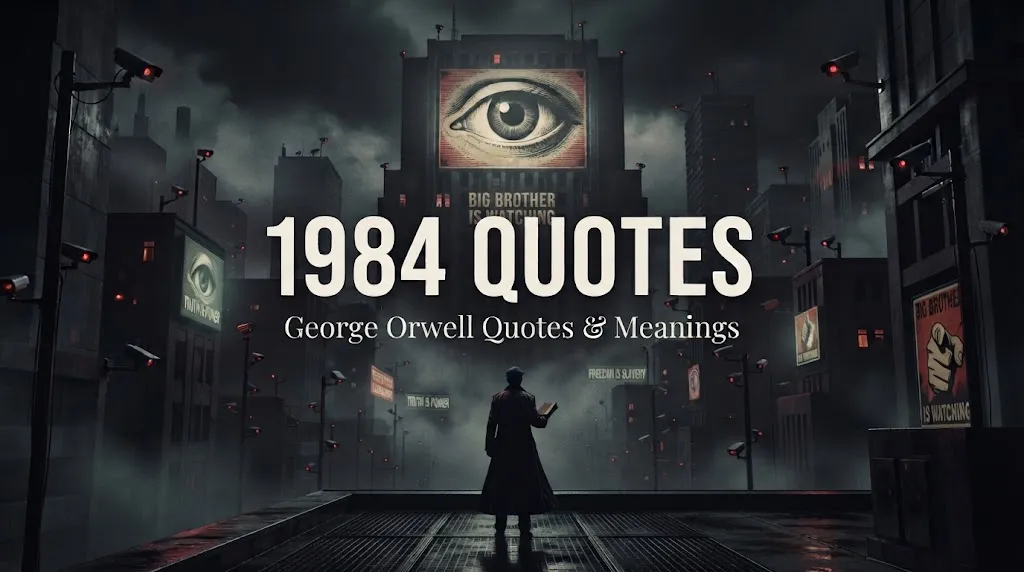
George Orwell’s 1984 is one of the most influential dystopian novels ever written. Its memorable lines explore freedom, truth, surveillance, propaganda, language, fear, love, power, memory, and the struggle to preserve individual thought.
This collection of 1984 Quotes goes beyond a simple list. The quotes are organized by theme, character, and idea, with concise explanations that show why each passage matters inside Orwell’s novel. From Big Brother and Newspeak to Winston Smith’s thoughts about truth and freedom, these themes reveal how language and information become instruments of control.
1984 was published in 1949 and is set in the fictional superstate of Oceania, where the Party exercises extraordinary control over information, history, language, relationships, and private thought.
1984 Quotes by George Orwell
Orwell’s novel is packed with lines that have become part of everyday political and literary language. These selections and thematic takeaways capture the ideas readers most often associate with 1984.
- “Who controls the past controls the future.” — A statement about historical power and memory.
- “War is peace.” — The first part of the Party’s famous contradictory slogan.
- “Freedom is slavery.” — The Party presents independence as dangerous.
- “Ignorance is strength.” — A slogan linking limited knowledge with political stability.
- “BIG BROTHER IS WATCHING YOU.” — The novel’s most recognizable surveillance warning.
- Winston’s private thoughts repeatedly contrast personal memory with official Party history.
- The novel questions whether truth can survive when every record can be altered.
- Orwell presents language as something that can either expand or restrict human thought.
- Winston’s diary represents a private attempt to preserve an individual reality.
- His relationship with Julia becomes an act of personal independence.
- The Party attempts to replace personal loyalty with loyalty to political authority.
- Memory becomes dangerous because remembering independently can challenge official history.
- Winston repeatedly searches for evidence that reality exists outside Party control.
- The novel connects political power with the ability to define what people are allowed to believe.
- Orwell ultimately presents independent thought as one of the most important forms of human freedom.
These ideas align with major themes identified in literary analysis of 1984, particularly totalitarian control, individualism, language, information, and history.
Famous 1984 Quotes
Some 1984 lines have survived far beyond the novel because they express complicated ideas in remarkably compact language.
- “War is peace.” — Contradiction becomes political doctrine.
- “Freedom is slavery.” — The Party reverses the ordinary meaning of freedom.
- “Ignorance is strength.” — Knowledge is portrayed as a threat to authority.
- “Big Brother is watching you.” — Surveillance becomes a permanent psychological presence.
- “Who controls the past controls the future.” — History becomes a source of power.
- “Who controls the present controls the past.” — Current authority determines the official historical record.
- The idea of doublethink requires people to accept contradictory ideas.
- The two-plus-two motif represents the struggle between objective reality and imposed belief.
- Winston’s diary symbolizes private memory.
- Newspeak represents deliberate restriction of language.
- The telescreen represents technological surveillance.
- Big Brother represents the Party’s omnipresent authority.
- The Ministry of Truth represents institutionalized manipulation of information.
- The paperweight represents Winston’s desire for a private world outside Party control.
- The final transformation of Winston demonstrates how completely authoritarian power can attack individuality.
SparkNotes identifies the Party slogans and historical-control quotation among the novel’s central famous passages.
Best 1984 Quotes About Freedom
Freedom in 1984 is not simply the ability to move around or speak openly. Orwell connects freedom to the ability to recognize reality, remember the past, love another person, and maintain an independent mind.
- Freedom begins with the ability to recognize reality.
- Independent thought becomes an act of resistance.
- Winston associates truth with the ability to state basic facts without fear.
- The Party treats independent judgment as a threat.
- Private memories become tiny pieces of personal freedom.
- Writing in a diary gives Winston a private space for thought.
- Julia’s rebellion begins partly through her refusal to surrender her private desires.
- Freedom requires more than physical escape.
- A person can be controlled even without visible chains.
- Language can either protect freedom or reduce the possibilities of thought.
- Historical memory gives people a reference point outside official propaganda.
- Personal relationships create loyalties that compete with Party authority.
- The desire for truth becomes a form of psychological resistance.
- Orwell shows how fear can make people surrender freedoms voluntarily.
- The novel asks whether freedom can survive when reality itself is controlled.
SparkNotes connects Winston’s idea of freedom with his struggle to preserve objective reality, particularly through the recurring two-plus-two motif.
1984 Quotes About Truth and Reality
Truth is one of the central battles in 1984. Winston’s work involves changing historical records, making the distinction between what happened and what the Party says happened increasingly unstable.
- “Who controls the past controls the future.” — Truth becomes politically useful.
- The Party can change yesterday’s facts by changing yesterday’s records.
- Winston understands that falsified records can make lies appear historically authentic.
- Objective reality becomes dangerous when it contradicts official ideology.
- Memory provides imperfect evidence against manufactured history.
- Winston searches for facts that exist independently of Party approval.
- The two-plus-two idea represents objective truth under attack.
- Reality becomes fragile when everyone is pressured to accept the same falsehood.
- Truth requires evidence, memory, and the courage to recognize contradictions.
- The Party does not merely hide information; it attempts to redefine reality.
- Winston’s work demonstrates how institutions can manufacture official narratives.
- The past becomes unstable when documents can be continuously rewritten.
- Personal memory and official history frequently collide.
- Truth becomes a form of rebellion because it limits political power.
- Orwell suggests that controlling reality in people’s minds can be more powerful than controlling their bodies.
SparkNotes specifically identifies historical revision and control of information as central mechanisms of Party power.
1984 Quotes About Power and Control
Power in 1984 reaches beyond government institutions. The Party attempts to influence language, history, sexuality, family relationships, emotions, and even private thought.
- Power becomes strongest when people begin policing themselves.
- Surveillance creates fear even when no officer is physically present.
- Propaganda makes political authority appear unavoidable.
- Historical revision protects the Party from contradiction.
- Language gives political power another method of controlling thought.
- Fear discourages people from testing official claims.
- The Party wants obedience rather than merely outward cooperation.
- Children can become instruments of political surveillance.
- Personal relationships become dangerous when they create loyalties outside the Party.
- The Party attempts to control both public behavior and private imagination.
- Contradictory slogans train citizens to accept impossible ideas.
- Institutions receive names that deliberately disguise their real functions.
- The Ministry of Truth manipulates information rather than simply reporting it.
- The Ministry of Love represents the Party’s coercive power.
- The ultimate form of control is forcing an individual to abandon an independently held belief.
The novel’s ministries, propaganda systems, surveillance technology, and psychological methods all contribute to this broader structure of control.
Big Brother Quotes From 1984
Big Brother is more than a character-like figure. He becomes a symbol of the Party’s constant presence and its claim to watch, protect, judge, and define reality.
- “BIG BROTHER IS WATCHING YOU.” — The defining surveillance slogan.
- Big Brother appears wherever citizens are reminded that they may be observed.
- His image turns political authority into a permanent visual presence.
- The uncertainty surrounding Big Brother strengthens his symbolic power.
- Citizens are encouraged to treat Big Brother as a protector.
- Fear and affection are deliberately mixed in the Party’s presentation of him.
- His image appears larger than ordinary human individuality.
- Big Brother represents authority that does not need to explain itself.
- The slogan turns surveillance into an everyday psychological condition.
- Big Brother’s presence makes privacy feel almost impossible.
- The Party uses his image to personalize an otherwise enormous political system.
- His apparent omnipresence helps citizens internalize obedience.
- Winston’s private hatred of Big Brother contrasts with public displays of loyalty.
- Big Brother symbolizes the Party’s claim over personal identity.
- The phrase remains powerful because it combines technology, authority, and fear in five simple words.
SparkNotes identifies the Big Brother slogan as one of the novel’s most important early signals of psychological domination and surveillance.
Winston Smith Quotes
Winston Smith is the novel’s central character and the lens through which readers experience the conflict between private memory and public ideology.
- Winston wants evidence that the world exists beyond Party declarations.
- His diary becomes a record of forbidden individuality.
- He recognizes contradictions that others have learned to ignore.
- Winston’s job forces him to participate in historical manipulation.
- He feels increasingly disconnected from the society around him.
- His memories of the past are incomplete but deeply important.
- Winston sees personal truth as more meaningful than official slogans.
- His curiosity creates danger.
- His relationship with Julia gives him a temporary sense of private life.
- Winston searches for people who might share his doubts.
- He becomes fascinated by objects connected with the past.
- His fear repeatedly competes with his desire to resist.
- He understands that rebellion begins in thought before it becomes action.
- His experience demonstrates the vulnerability of individuality under sustained coercion.
- Winston’s story ultimately asks how much of the self can survive when both memory and reality are attacked.
Winston’s work at the Ministry of Truth is directly connected to the Party’s manipulation of history and information.
1984 Quotes About Surveillance
Surveillance is one of the most recognizable elements of Orwell’s dystopian world. Telescreens, microphones, posters, and social pressure make citizens feel watched even inside supposedly private spaces.
- “BIG BROTHER IS WATCHING YOU.”
- Surveillance creates obedience through uncertainty.
- People behave differently when they believe observation is possible.
- The telescreen combines communication with monitoring.
- Privacy becomes a form of rebellion.
- The Party does not need to reveal exactly when someone is being watched.
- Fear of observation encourages people to censor themselves.
- Technology becomes dangerous when controlled without meaningful limits.
- Surveillance affects facial expressions, conversations, relationships, and habits.
- Citizens learn to hide their genuine emotions.
- Even children participate in the culture of suspicion.
- Private spaces become psychologically unsafe.
- The threat of observation can be more powerful than actual observation.
- Surveillance changes how people understand trust.
- Orwell connects technological monitoring with the broader loss of personal independence.
The telescreens and hidden microphones are described as major mechanisms through which the Party monitors citizens.
1984 Quotes About War and Peace
War in 1984 is not presented simply as a military event. It is also connected to propaganda, scarcity, political unity, fear, and the Party’s ability to control public perception.
- “War is peace.”
- War gives the Party an external enemy.
- Constant conflict helps maintain a permanent emergency atmosphere.
- Citizens are encouraged to connect patriotism with obedience.
- The enemy can change without changing the Party’s certainty.
- War propaganda influences how citizens interpret events.
- Military conflict becomes part of political storytelling.
- The Party’s language makes contradictions appear normal.
- Peace is redefined according to political usefulness.
- Citizens are expected to accept official explanations immediately.
- War creates a reason for continued sacrifice.
- Fear of enemies strengthens dependence on authority.
- Information about war is filtered through Party-controlled media.
- The public narrative matters as much as the battlefield.
- Orwell shows how war can become an instrument of domestic control.
The Party slogans are introduced early in the novel and are closely associated with the concept of doublethink.
1984 Quotes About Newspeak and Language
Newspeak is one of Orwell’s most important ideas because it connects vocabulary with the limits of thought. The Party wants language to become increasingly precise for political control while simultaneously eliminating words that could support rebellion.
- Newspeak is designed to restrict the vocabulary available for independent thought.
- Syme understands that reducing language can reduce the ability to formulate forbidden ideas.
- The Party wants political concepts to become increasingly difficult to express.
- Language becomes an administrative tool rather than a space for creativity.
- Doublethink depends partly on accepting contradictions through controlled language.
- Words can be removed before ideas are openly banned.
- Newspeak turns political ideology into everyday vocabulary.
- The Party treats language as something that can be engineered.
- Reducing synonyms reduces opportunities for subtle expression.
- Political language becomes deliberately narrow.
- Winston’s concern with ordinary language contrasts with Party terminology.
- Newspeak illustrates the connection between vocabulary and imagination.
- Language can preserve memory, but it can also erase distinctions.
- Orwell presents linguistic control as a long-term political strategy.
- The struggle over words becomes a struggle over what people can think and communicate.
SparkNotes describes Newspeak as an attempt to make rebellious thought increasingly difficult by limiting the language available for expressing it.
1984 Quotes About Fear and Oppression
Fear is everywhere in 1984. It does not simply come from physical punishment; it is built into daily life through surveillance, uncertainty, propaganda, and the possibility of betrayal.
- Fear teaches people to hide their genuine thoughts.
- The possibility of punishment changes ordinary behavior.
- Citizens learn that suspicion itself can be dangerous.
- Children can become sources of fear within families.
- Physical pain eventually becomes part of the Party’s psychological control.
- Fear makes independent thought difficult to sustain.
- Public displays of enthusiasm can conceal private terror.
- The Thought Police represent punishment for forbidden ideas.
- The Party creates uncertainty about who can be trusted.
- Fear isolates individuals from one another.
- Emotional control becomes easier when people expect betrayal.
- Oppression reaches both public and private life.
- Fear can make people accept contradictions they would otherwise reject.
- Winston’s anxiety shows how surveillance becomes internalized.
- Orwell presents oppression as a system rather than a single act of violence.
The novel’s themes of psychological manipulation, surveillance, propaganda, and physical coercion are closely interconnected.
1984 Quotes About Rebellion and Resistance
Winston’s rebellion begins quietly. Writing in a diary, remembering the past, questioning official claims, and developing a private relationship all become forms of resistance.
- Writing down forbidden thoughts becomes an act of rebellion.
- Remembering the past independently challenges Party history.
- Asking whether something is true becomes politically dangerous.
- Winston’s diary creates a private record outside official control.
- His relationship with Julia challenges the Party’s control over intimacy.
- The desire for truth becomes a form of resistance.
- Individual identity conflicts with collective political obedience.
- Winston looks for others who may question the system.
- Small acts can carry enormous psychological meaning.
- Resistance begins before physical rebellion.
- The Party fears independent thinking because ideas can spread.
- Winston’s curiosity gradually becomes active defiance.
- Personal memory provides a possible foundation for resistance.
- The novel questions whether resistance can survive systematic psychological control.
- Orwell distinguishes between resistance as an individual impulse and organized revolution.
SparkNotes describes Winston’s diary, relationship with Julia, and attempts to preserve individuality as significant forms of resistance.
1984 Quotes About Love and Relationships
Love and intimacy are politically important in 1984 because personal relationships can create loyalties that compete with the Party.
- “Perhaps one did not want to be loved so much as to be understood.” — Winston’s desire for emotional recognition.
- Winston’s relationship with Julia creates a private world.
- Love becomes dangerous when political authority demands total loyalty.
- Julia’s independence challenges the Party’s expectations.
- Private intimacy gives Winston an identity outside his public role.
- The Party treats uncontrolled sexuality as a threat.
- Personal desire becomes politically significant.
- Trust becomes difficult in a society built around surveillance.
- Relationships create emotional loyalties that the Party cannot completely define.
- Winston’s memories of human connection contrast with Party collectivism.
- Love gives him a temporary sense of normality.
- The rented room becomes a symbol of private life.
- The relationship shows why the Party attempts to regulate intimacy.
- Personal affection can become a challenge to political absolutism.
- Orwell shows how authoritarian systems can attempt to control not only what people think but whom they love.
SparkNotes notes that Winston and Julia’s relationship represents an assertion of individuality against Party control.
Dark 1984 Quotes
The darkest ideas in 1984 are often the ones that challenge the reader’s assumptions about reality, memory, identity, and human independence.
- “2 + 2 = 5” becomes a symbol of imposed reality.
- The Party seeks obedience deeper than outward behavior.
- Memory can be manipulated until people doubt themselves.
- Truth becomes dangerous when authority controls the evidence.
- Surveillance turns ordinary life into psychological pressure.
- Language can be redesigned to eliminate uncomfortable ideas.
- Fear can destroy trust between family members.
- Children can be trained to monitor adults.
- The past can disappear when records are continuously rewritten.
- Political power can invade intimate relationships.
- Contradiction becomes normal under doublethink.
- The Party wants loyalty that survives evidence and reason.
- Identity becomes vulnerable when private memories are attacked.
- The individual can be isolated until resistance feels impossible.
- The novel’s darkest warning concerns the destruction of independent reality itself.
SparkNotes connects the two-plus-two motif directly with the Party’s attempt to control objective reality and psychological independence.
1984 Quotes About History and Memory
History is one of the most important battlegrounds in the novel. Winston’s work demonstrates how official records can be changed to make the present version of the Party appear permanently correct.
- “Who controls the past controls the future.”
- “Who controls the present controls the past.”
- Historical records can be altered to match current Party policy.
- Winston’s job turns memory into an administrative process.
- Forgotten events become easier to manipulate.
- Personal memories can conflict with official documents.
- The Party removes evidence that contradicts its narrative.
- Historical uncertainty weakens people’s ability to challenge authority.
- The past becomes whatever the surviving records appear to prove.
- Memory gives individuals a connection to a world beyond political messaging.
- Winston searches for evidence from earlier generations.
- Photographs and documents become dangerous because they preserve alternative histories.
- The Party understands that historical control strengthens present authority.
- Remembering becomes a quiet form of resistance.
- Orwell shows that destroying historical evidence can change how people understand themselves.
The novel explicitly connects historical revision with political control, particularly through Winston’s work at the Ministry of Truth.
1984 Quotes About Individuality
Individuality is constantly threatened in Oceania. The Party wants citizens to identify primarily as members of a collective rather than as independent people with private beliefs.
- Winston’s diary represents an attempt to preserve individuality.
- Private memories distinguish Winston from official Party history.
- Independent thought becomes dangerous.
- Personal relationships create identities beyond political roles.
- Individual language can preserve distinctions that Newspeak attempts to remove.
- Personal objects can carry memories that institutions cannot completely control.
- The paperweight becomes associated with Winston’s private world.
- Individual desires conflict with the Party’s demands.
- Fear encourages citizens to suppress visible personality.
- Surveillance discourages authentic behavior.
- Independent judgment becomes a form of intellectual freedom.
- The Party seeks emotional as well as political conformity.
- Winston’s identity depends partly on his memories.
- Losing independent memory means losing part of the self.
- Orwell portrays individuality as something that requires both inner freedom and external reality.
SparkNotes identifies psychological attacks on individualism as one of the novel’s major themes.
Most Famous 1984 Party Slogans Explained
The Party’s slogans are deliberately contradictory. Their purpose is not simply to persuade citizens but to train them to accept incompatible ideas simultaneously.
| Party slogan | What it suggests |
| War is peace | Permanent conflict can be presented as necessary for social stability. |
| Freedom is slavery | Individual independence can be portrayed as dangerous. |
| Ignorance is strength | Limited knowledge can protect political authority. |
The three slogans appear prominently in the opening chapter and introduce Orwell’s concept of doublethink, in which citizens are expected to accept contradictory ideas without resolving the contradiction.
Other important Party concepts include:
- Big Brother — symbolic political authority.
- Doublethink — simultaneous acceptance of contradictory ideas.
- Newspeak — politically engineered language.
- Thoughtcrime — forbidden thought.
- Thought Police — enforcement of ideological conformity.
- Telescreens — communication and surveillance technology.
- Ministry of Truth — institutional control of information.
- Ministry of Love — coercion and punishment.
- Ministry of Peace — associated with war.
- Ministry of Plenty — associated with economic scarcity.
- Unperson — someone erased from official existence.
- Proles — the large working-class population outside the Party.
- Oceania — the superstate in which Winston lives.
- Goldstein — the supposed enemy used in Party propaganda.
- Doublethink — the psychological foundation that allows contradictions to become official truth.
SparkNotes identifies the deliberately contradictory ministry names as an important motif in the novel.
What Do the Quotes in 1984 Mean?
The easiest way to understand Orwell’s quotations is to connect each memorable line with the larger idea behind it.
Related to Another Article:https://laughaura.com/positivity-quotes/
What does “Who controls the past controls the future” mean?
It refers to the political importance of controlling historical records. If authorities can determine what people believe happened before, they can influence how people understand the present and imagine the future.
What does “Big Brother is watching you” mean?
It represents constant surveillance and the psychological effect of knowing that authority may be observing you.
What does “War is peace” mean?
The slogan demonstrates how the Party uses contradiction to redefine political reality. War can be presented as necessary for stability and unity.
What does “Freedom is slavery” mean?
The Party reframes independence as dangerous and presents obedience to the collective as a form of security.
What does “Ignorance is strength” mean?
The slogan suggests that citizens who cannot recognize contradictions are easier for the Party to control.
What does “2 + 2 = 5” represent?
It symbolizes the Party’s attempt to make people surrender objective reality and accept whatever authority declares to be true. SparkNotes connects this motif directly to Winston’s struggle for intellectual independence.
What is Newspeak?
Newspeak is the Party’s engineered language, designed to narrow vocabulary and make certain forms of independent or rebellious thought increasingly difficult to express.
Why are 1984 quotes still famous?
Many of Orwell’s phrases have entered everyday discussions about surveillance, propaganda, political language, privacy, information, and authoritarian power.
Why Are 1984 Quotes Still Relevant?
1984 remains widely discussed because its central ideas extend beyond the fictional world of Oceania.
The novel explores several questions that continue to matter in discussions about society and information:
- Who controls information?
- How does propaganda influence perception?
- What happens when historical records are manipulated?
- Can technology increase surveillance?
- How does language influence thought?
- Why does privacy matter?
- How can people distinguish evidence from political messaging?
- What happens when contradictory claims become normalized?
- How does fear change behavior?
- What role does memory play in personal identity?
Orwell’s influence can also be seen in modern vocabulary. Terms such as Big Brother and Newspeak have become widely recognized references beyond the novel itself.
The enduring value of these quotations is therefore not simply that they sound dramatic. Their strength comes from the larger questions behind them.
People Also Ask
Several lines are widely recognized, including “Big Brother is watching you,” the three Party slogans, and the statement about controlling the past and future. SparkNotes identifies these among the novel’s central famous quotations.
The three slogans are “War is peace,” “Freedom is slavery,” and “Ignorance is strength.” They appear prominently at the Ministry of Truth and embody the Party’s use of contradictory political logic.
The most recognizable Big Brother slogan is “BIG BROTHER IS WATCHING YOU.” It establishes the novel’s atmosphere of surveillance from the opening chapter.
The quotations come from George Orwell’s novel Nineteen Eighty-Four, commonly called 1984, which was published in 1949.
It represents the Party’s attempt to force people to accept an official claim even when it contradicts observable reality. It becomes a major symbol of psychological control.
How to Use 1984 Quotes in Essays, Captions & Discussions
The best quotation depends on the purpose.
| Purpose | Useful theme |
| Literature essay | Truth, language, power, history |
| School assignment | Doublethink, surveillance, individuality |
| Social media post | Big Brother, freedom, truth |
| Book discussion | Memory, rebellion, relationships |
| Philosophy discussion | Reality, knowledge, identity |
| Political-language analysis | Propaganda, Newspeak, slogans |
| Literary analysis | Symbolism, motifs, characterization |
| Personal reflection | Freedom, individuality, privacy |
For academic writing, identify the speaker or context where appropriate and explain the quotation rather than placing it on the page without analysis.
For social media, a short quotation accompanied by your own interpretation can be more useful than a long quotation dump.
Conclusion
The most Memorable 1984 quotes are powerful because they are connected to much bigger ideas. Orwell uses short slogans, character dialogue, invented language, and recurring symbols to examine truth, freedom, surveillance, power, memory, and individuality.
From “Big Brother is watching you” to the Party’s contradictory slogans and the warning about controlling the past, the novel repeatedly asks readers to think about who controls information and how that control can affect human independence.
Instead of reading these quotations as isolated lines, consider the context surrounding them. Winston’s story, the Party’s manipulation of history, Newspeak, surveillance, and the struggle between private memory and official truth all give Orwell’s words their lasting force.
If you found a quotation that made you stop and think, save this collection for your next literature discussion, essay, book-club conversation, or social post.
Entertainment and literary-analysis note: This article is intended for educational, informational, and entertainment purposes. Quotations from 1984 are presented selectively with commentary and context rather than as a replacement for the original novel.










1 thought on “1984 Quotes: George Orwell Quotes & Meanings”